
RESINBAU COMPONENT RATIOS
Product mixing
Select a product, specify the quantity and check how much of each component to prepare. Litres indicate volume; kilograms indicate mass.
B1 polymer density · calculation assumption
The default 1.13 kg/l is a working assumption for B1. It is not a confirmed density of the polymer alone. You can enter the value appropriate to the B1 used.
B1 volume is matched to A1+A2 volume. B2 powder increases batch mass; its effect on volume is disregarded in this calculation.
Enter a quantity to see the mixture composition.
ACRYLGEL PREPARATION
Two mixtures, four components
First prepare A1+A2 and B1+B2 separately. The B1 base volume corresponds to the A1+A2 volume; adding B2 powder increases mass.
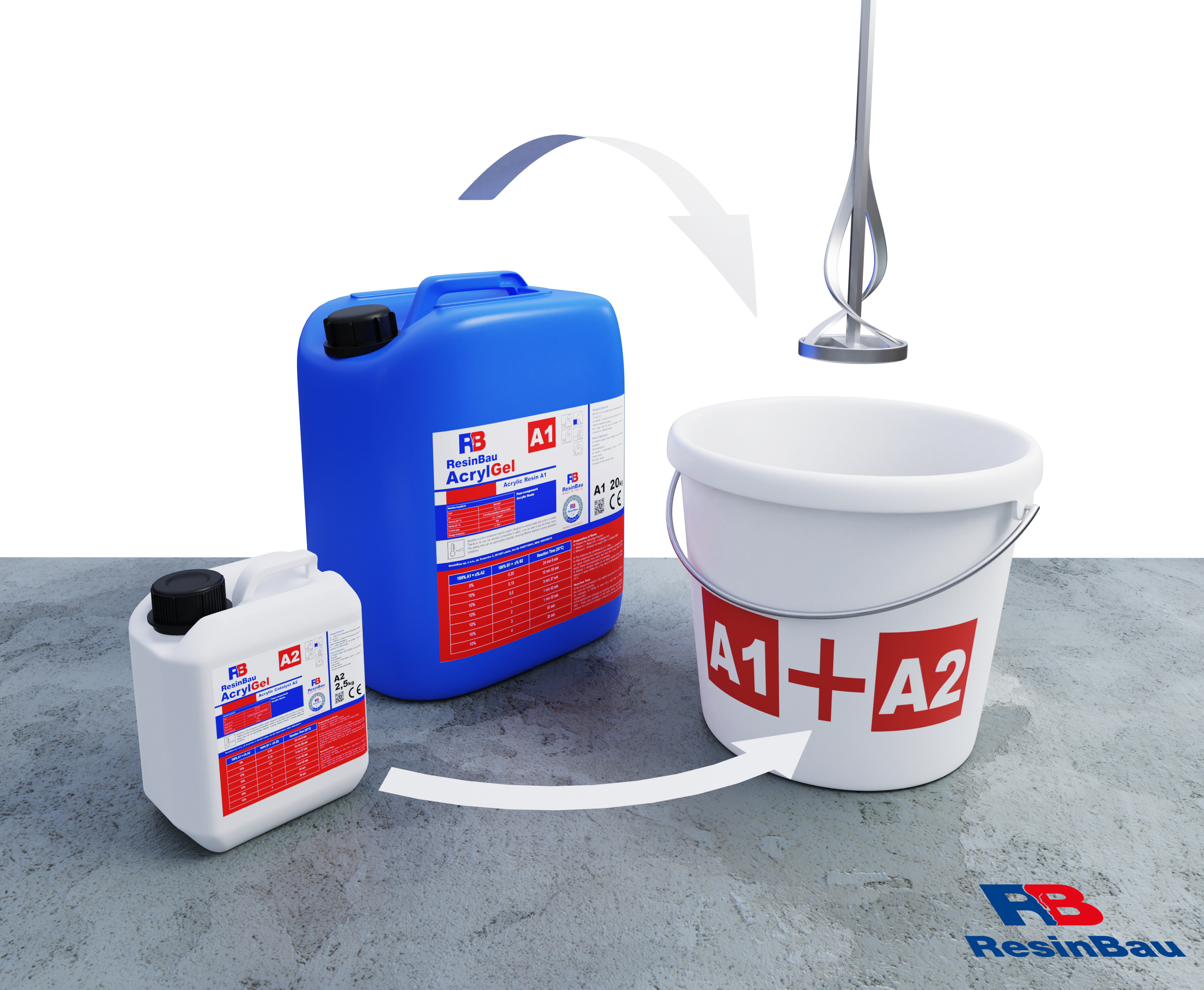
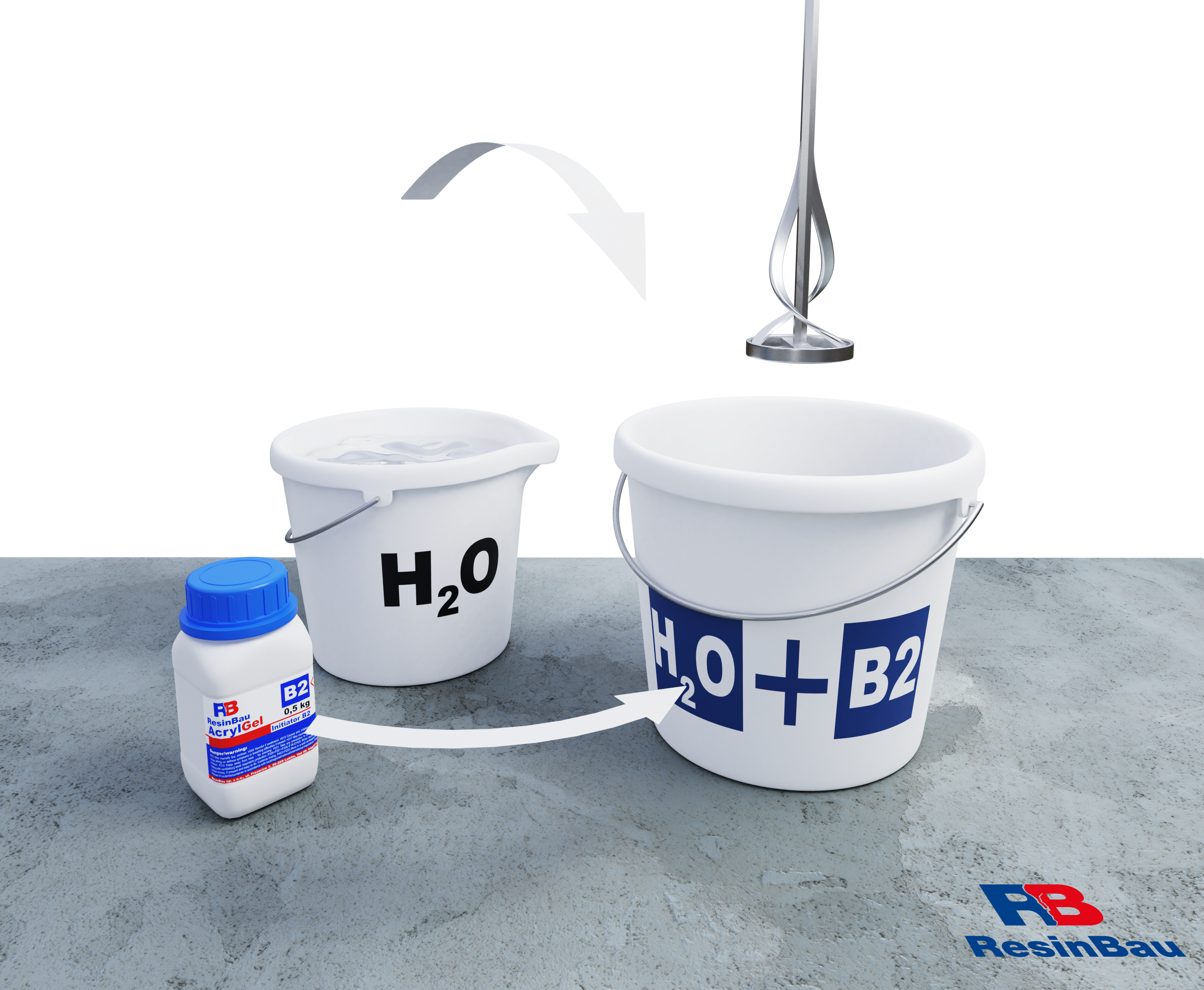
Preparation and delivery
Piston pump dosing and component temperature
A 1:1 volume ratio means equal volumes of components A and B. Different component densities produce different masses; this alone does not require changing the pump ratio setting.
Temperature affects viscosity, pump feed and reaction behaviour. Thermal conditioning of components can support stable dosing. Temperature selection for a specific material and device should account for the application range, technical recommendations and pump instructions.
Before application, confirm the delivery ratio by measuring both line outputs according to the equipment instructions. Temperature adjustment prepares the material for dosing and does not replace ratio checks. Product parameters refer to the formulation and test conditions; the calculator does not determine permissible A:B deviation or a temperature to compensate for it.
How should litres, kilograms and ratios be read?
Small quantities are shown in millilitres and grams; larger quantities in litres and kilograms. Results display up to two decimal places; calculations retain full precision.
For measuring in litres, we use the volume ratio. For weighing, we use the product's stated mass ratio; for CrackFlex and GeoTrack, this is calculated from the assumed component densities and a 1:1 volume ratio. Quantities in the other unit are indicative conversions.
Densities and ratios stated in documentation are rounded. An auxiliary mass-to-volume conversion may therefore not produce exactly the same figures as a separate volume ratio. Prepared batch mass is the sum of component masses. Liquid volumes are added approximately, before reaction; for mortars, powder and water volumes are not added together.