Skip to content

Calculator

Crack drilling

Set the target position, angle and additional depth. Observe the changing geometry and compare 30°, 45° and 60° options.

CATALOGUE VERSION

Standard calculator

Enter dimensions and select drilling parameters. The drawing explains the selected field and results update automatically.

Direct link to the standard version ↗

Full thickness of the concrete element.

Position of the crack intersection point, measured from the drilling surface.

Extension of the hole beyond the crack intersection point.

Used as the hole diameter in the volume calculation.

Drilling angle for preview

Angle measured from the surface. Results for all three options are shown below.

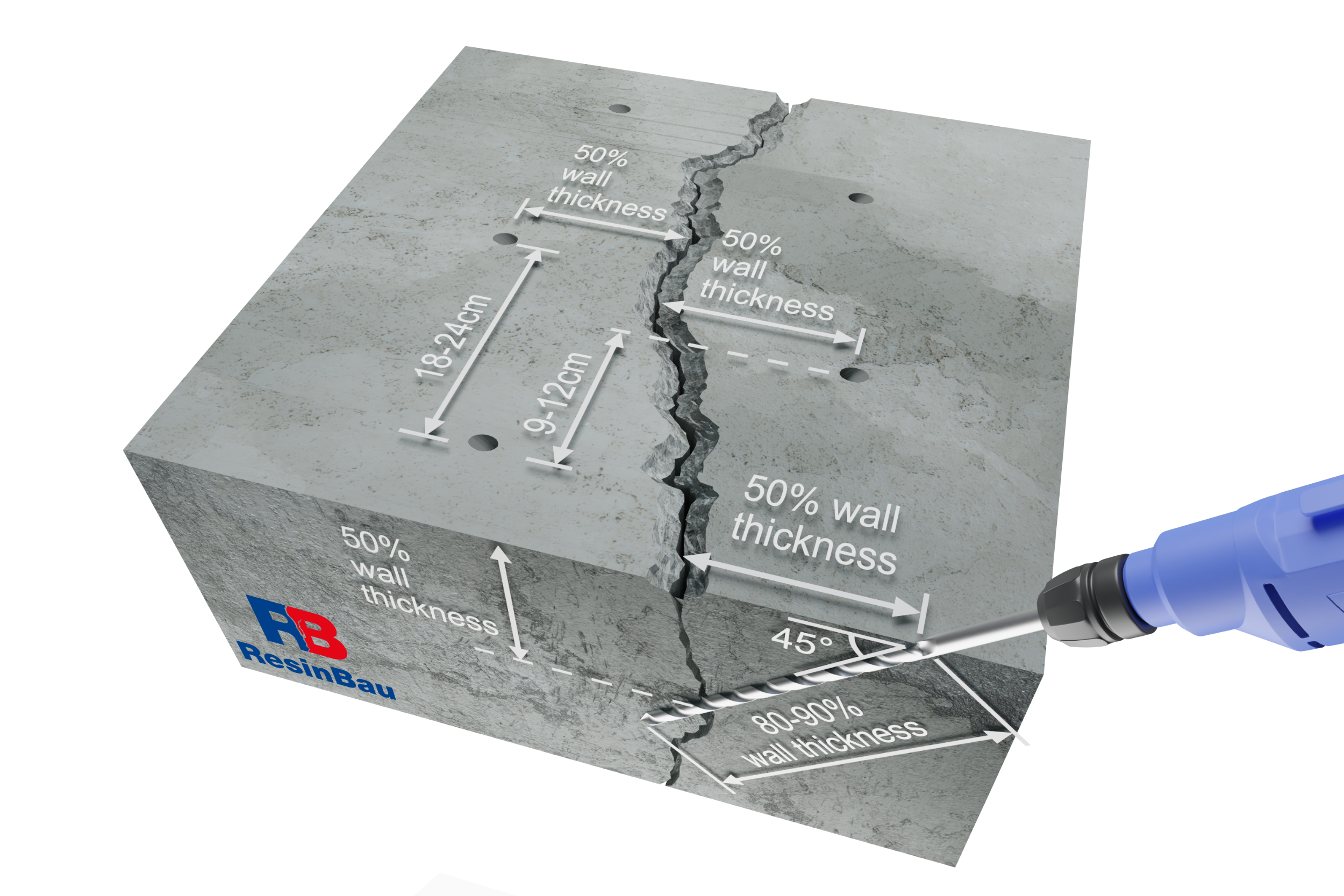
Original ResinBau drawing: angled drilling intersecting a crack in a concrete element. — The arrows across the crack and on the cut face indicate 50% of wall thickness. Drill at 45°. Along the crack, the illustrated spacing is 18–24 cm between holes on the same side and 9–12 cm between alternating holes. The sloping arrow along the bore indicates 80–90% of wall thickness.

Structure thickness

The catalogue drawing shows an example at 45° and 50% thickness. The red mark indicates the element being discussed; the illustration and its printed dimensions do not scale with the data.

Diagram key

The arrows across the crack and on the cut face indicate 50% of wall thickness. Drill at 45°. Along the crack, the illustrated spacing is 18–24 cm between holes on the same side and 9–12 cm between alternating holes. The sloping arrow along the bore indicates 80–90% of wall thickness.

Enable JavaScript for interactive calculations.

STEP 2 · PACKER ARRANGEMENT

Where should the next hole be drilled?

The hole geometry is already set. Now choose the spacing of successive points along the crack, alternating on both sides.

Structure thickness from the calculator—

From point 1 to point 2, measured along the crack. This is not the diagonal distance between packers.

Every other hole, on the same side—

Changing the spacing does not change the angle, hole length or crack offset in step 1.

TOP VIEW OF THE SURFACEAlternating arrangement
Spacing along the crack — set hereOffset from the crack — from step 1

Arrangement diagram, not a drilling plan to scale. Numbers show the point sequence. On a curved crack, measure spacing along its path.

01 / STARTING POINT

Next packer: spacing of 50% of the structure thickness

Start with spacing along the crack equal to 50% of the wall or slab thickness. Place the next packer on the opposite side of the crack. Example: 20 cm concrete thickness → the next point 10 cm further along the crack, with points on the same side every 20 cm. This is port spacing, not crack intersection depth.

02 / NO TRANSFER

No transfer? Reduce port spacing

If material does not reach the next port, check that the holes intersect the crack and are clear. Fine hairline cracks in particular may require closer spacing between successive ports. Reduce spacing until material transfer is achieved.

03 / CONFIRMED FLOW

Assess flow to the next port

If material readily reaches the next port and you confirm filling of the crack section, consider wider spacing of subsequent holes, meaning fewer packers per linear metre. Leakage onto the concrete surface is different: it may indicate an inadequate crack face seal. Check surface sealing before assessing spacing.

What do the stated dimensions mean?

Measure the crack offset on the concrete surface — this is where drilling starts. Measure the drilling angle from that surface. Drilling depth is the hole length along the bit, including the extension beyond the crack. Spacing in step 2 indicates how far to move along the crack to the next hole on the opposite side.

What must be checked on site?

The calculator assumes that the crack runs perpendicular to the concrete surface. In practice it may change direction — check that the hole intersects it and material reaches the next port. Hole volume is the capacity of the empty drilled hole before installing the packer. It does not determine the resin quantity needed to fill the crack.

Full article and calculation examples ↗