Gel deep in the gap
Forms a flexible filling. Adding polymer does not replace a finish that protects exposed gel against water loss.

FILLING MATERIAL QUANTITY
Enter the total joint length and filling cross-section. Check how many litres of material you need in total and per metre.
WHAT ARE YOU ENTERING?
Diagram of the cross-section and a representative joint section. Length L is the sum of the sections; length and cross-section use independent scales.
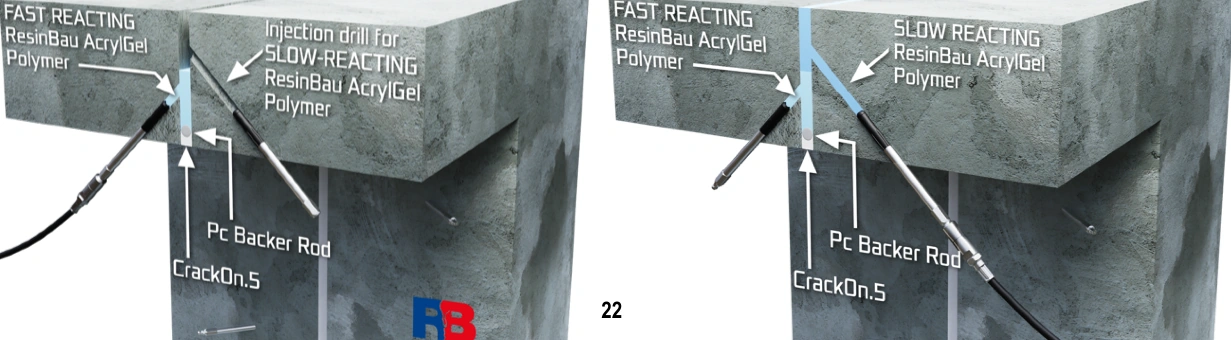
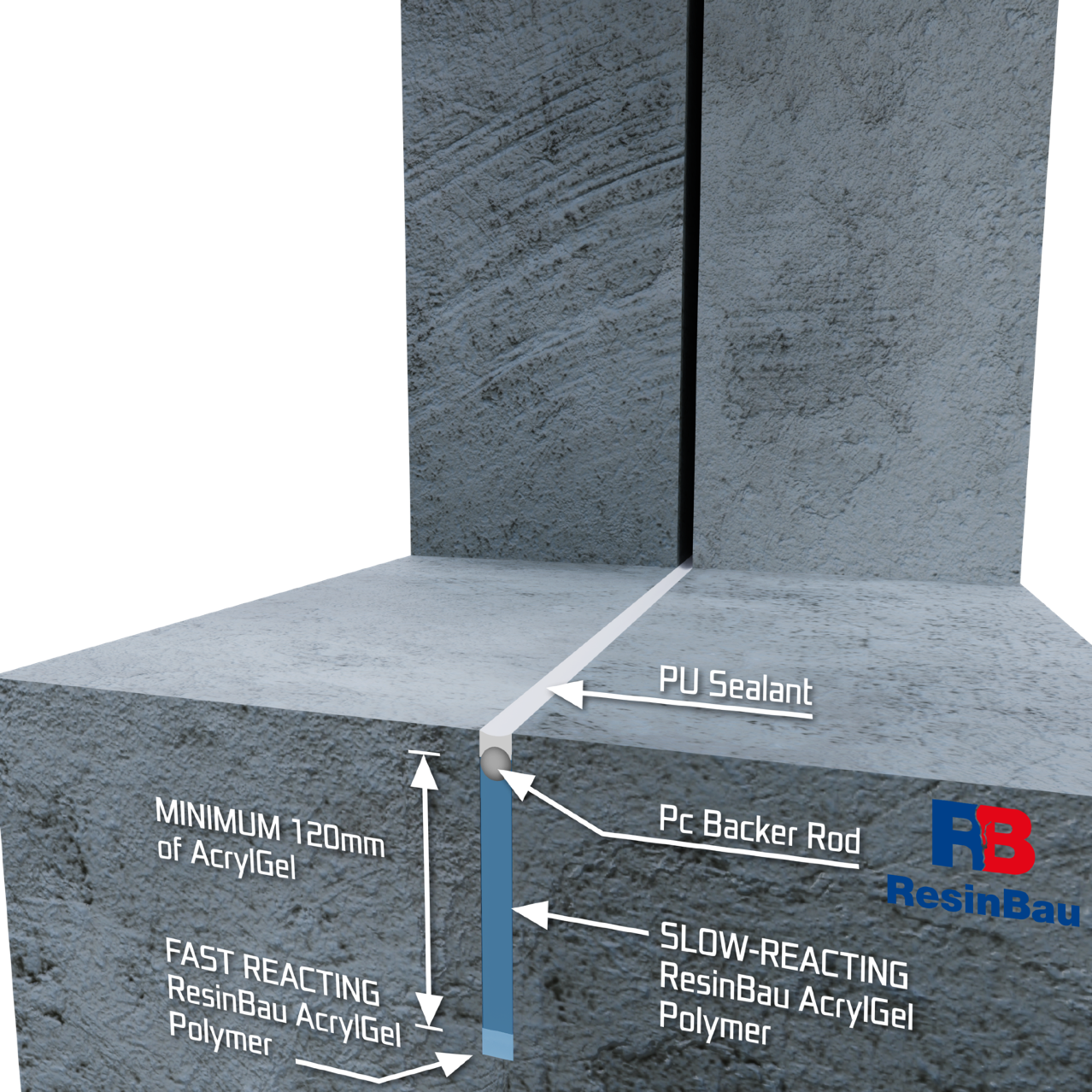
System from the access side into the gap. Backer rods are shown schematically; their occupied zones are calculated as strips of the specified depth, without correcting for voids around the rounded profile. CrackOn.5 is removed before finishing with flexible polyurethane sealant.
FILLING IS ONE STAGE OF THE WORK
Soft gel alone does not constitute a finished expansion joint.
ResinBau AcrylGel + Polymer fills the prepared gap. However, conditions in the structure can alternate between wet and dry. The gel may release water and shrink, then regain volume when wetted again. In the solution shown, we therefore protect its exposed face instead of leaving it in contact with air.
 Enlarge drawing ↗
Forms a flexible filling. Adding polymer does not replace a finish that protects exposed gel against water loss.
Helps set the sealant depth and separate it from the filling. The rod alone is not the final sealing layer.
Closes the gap surface and limits drying from the access side. Selection of the sealant and its cross-section must account for joint movement.
Select gel depth and finishing cross-section for the repair conditions. The calculator's initial 12.5 cm does not represent a universal “drying layer”. Flexible polyurethane sealant is part of the solution shown and is outside the ResinBau range.
In layer mode, gel volume follows its own depth h + Δh. Backer rods and closures occupy additional space. Required system depth is given separately for injection and finishing; CrackOn.5 and polyurethane sealant are not added as simultaneous layers.
CrackOn.5: approximately 2 kg of dry mix per litre of fresh mortar. Flexible polyurethane sealant: strip volume at the entered average depth. Backer rod: one metre per metre of joint for each new run. Allowances for other materials are added separately. Select compound dimensions and the rod purchase diameter for the specific product.
Volume in litres = length in metres × width in cm × total depth in cm ÷ 10. Total depth is h + Δh. The percentage allowance is added at the end.
Additional depth means more space to fill. It does not replace surface sealing that protects the gel from drying. For large movements, including seismic movement, the cross-section and sealing system require individual selection.
The result is the volume of prepared material required to fill the assumed geometry. It excludes unknown voids and material escaping beyond the joint. We do not automatically convert it to kilograms of concentrate.
INSTALLATION METHOD
Find cleaning, closure and material delivery details in the repair guide.
View expansion joint repair →